Exporting To India From New Zealand
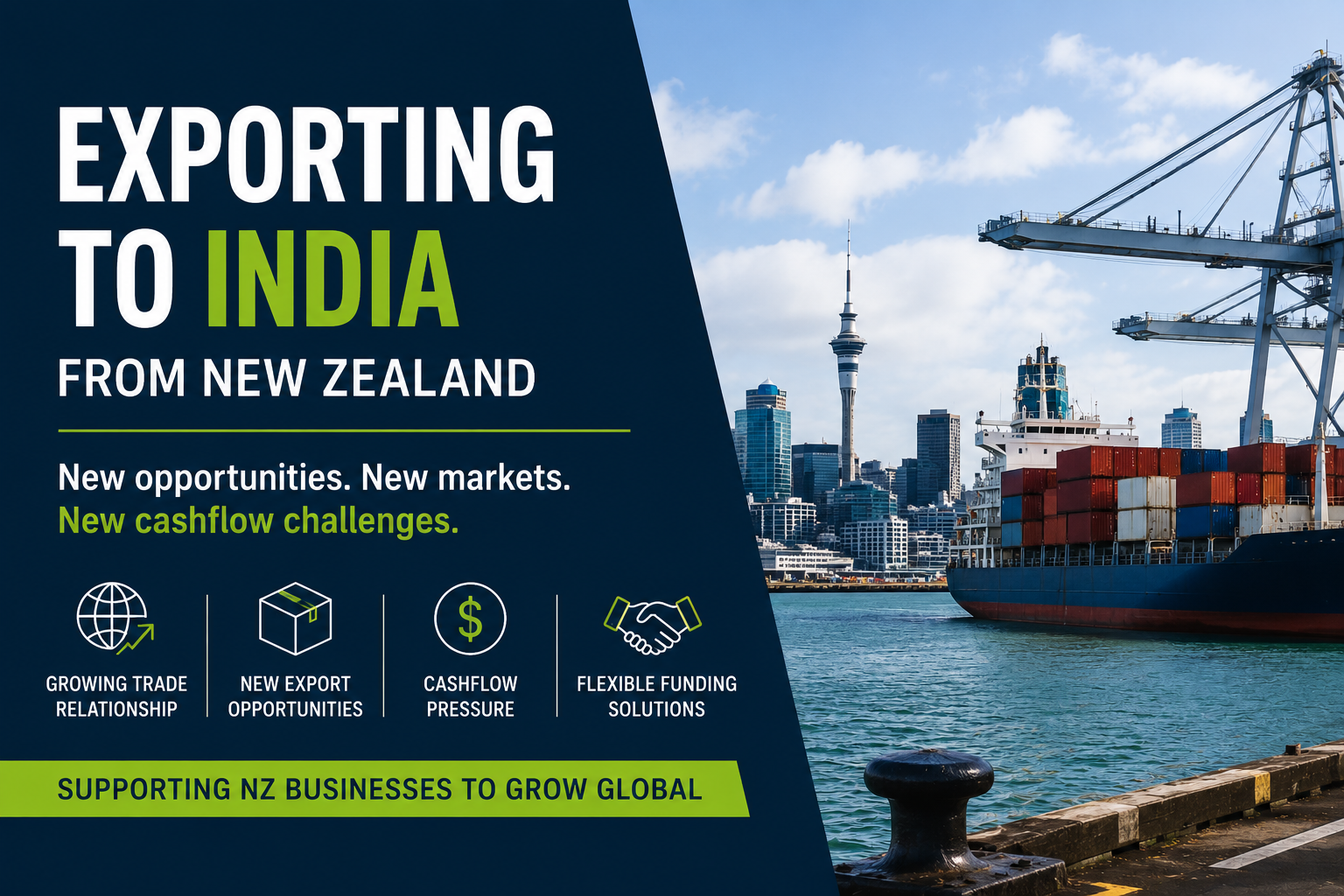
Why More NZ Businesses Are Exploring India And Why Cashflow Will Matter More Than Ever
The NZ–India Free Trade Agreement could become one of the biggest trade opportunities we’ve seen for New Zealand businesses in years.
Reduced tariffs, improved market access, and stronger trade ties between the two countries should create real momentum across industries like food & beverage, agriculture, manufacturing, wholesale, importing, and exporting.
What I am seeing and hearing in market
I recently spent time speaking with a number of banking and finance professionals to better understand one question:
Could the growing trade relationship between India and New Zealand create real opportunities for NZ exporters and businesses?
The feedback was largely positive. Most people I spoke with see the NZ–India Free Trade Agreement as a significant long-term opportunity for New Zealand businesses, particularly across industries like:
agriculture, food & beverage, manufacturing, importing and exporting, wholesale trade, and supply chain distribution.
The potential benefits are obvious.
Reduced tariffs, improved market access, and stronger trade relationships between the two countries could create substantial growth opportunities for New Zealand exporters looking to access one of the world’s largest and fastest-growing consumer markets.
But after digging deeper into conversations with banks, exporters, and finance professionals, one theme kept coming up repeatedly:
Opportunity is growing faster than trust
While many banks see the long-term potential, there’s still caution around Indian banking relationships and trade exposure from New Zealand. And to be fair, that caution is understandable.
Cross-border trade relationships take time to mature. Traditional lenders naturally want to see:
stronger historical transaction data,
proven payment behaviour,
established banking infrastructure,
reliable correspondent banking relationships,
and trusted operators on both sides of the transaction.
Most businesses and most banks do not want to be the first ones aggressively stepping into a developing trade corridor.
They want proof first.
“We’ve been burnt before”
One of the more interesting conversations I had recently was with a customer exporting fruit into the US and Asian markets. When discussing international trade expansion, they said something that really stood out to me:
“It’s been the relationship on the other side. We’ve been burnt in the past.”
That comment probably summarises the biggest challenge in emerging trade relationships better than anything else.
In international trade, products matter. Pricing matters. Margins matter. But trust matters more.
The feedback I heard repeatedly was that businesses need confidence in the buyer, the infrastructure, the local relationships and the verification process on the ground.
There’s also a strong desire for independent quality control reporting and trusted third-party verification in overseas markets.
For many NZ exporters, especially in agriculture and food-related sectors, that independent validation is critical.
Without it, risk perception increases quickly.
Many businesses don’t want to be first
Another point that came up several times was that many businesses are happy to wait for larger operators to move first. That’s fairly normal in international trade. Smaller and mid-sized businesses often prefer to see major exporters establish successful trading patterns, banking relationships deepen and infrastructure improve,
The challenge with that approach is that early opportunities are often captured by businesses willing to move before the market feels completely comfortable.
That doesn’t mean moving recklessly. But it does mean understanding that developing trade corridors naturally go through a phase where opportunity exists before traditional systems fully catch up.
Where Specialist Funders like us can play a role
This is where I believe specialist funders like Pacific Invoice Finance New Zealand (PIFNZ) can help bridge the gap. In emerging trade relationships, flexibility matters. Businesses entering new export markets often need:
working capital,
cash flow flexibility,
and funding structures that can adapt while the market matures.
Traditional lenders are generally structured around historical transactions and financial performance. Specialist funders can often assess opportunities differently.
At PIFNZ, if we can secure appropriate protection particularly trade credit insurance on the customer, we have the ability to be commercially flexible and support opportunities that may still sit outside the comfort zone of more traditional lenders.
Trade credit insurance can play a particularly important role in emerging international trade relationships because it helps reduce exposure around customer default and payment risk.
The Businesses That Move Early May Benefit Most
In my view, the NZ–India trade relationship has enormous long-term potential. But like any developing international trade corridor, there will likely be a transition period where:
trust is still being built,
infrastructure is still developing,
and financial institutions are still assessing risk appetite.
That period may also create opportunity. The businesses that build strong relationships early, establish trusted local partnerships, and structure transactions properly may ultimately be the ones best positioned as trade volumes continue growing over the coming years.
And for those businesses, having flexible funding partners alongside them may become increasingly important.
Or learn more: